
Pumps for vinegar, mustard and acidic sauces: what to consider when transferring these products?
To correctly assess the choice of materials and pump configurations suitable for transferring condiments such as vinegar, mustard and acidic sauces, it is necessary to consider a range of factors. In addition to pH values, the product’s composition, temperature, the flow rate required by the system and cleaning conditions are also important.
A pneumatic double-diaphragm pump may be suitable for transferring these products. However, to select the right one, it is necessary to assess both the system requirements and all the components in contact with the fluid.
What factors influence the choice of pump for vinegar, mustard and acidic sauces?
To choose a pump for vinegar, you need data on the actual formulation, the temperature during transfer and the materials that will be in contact with the product. The pH value alone is not sufficient to confirm the compatibility of the configuration. Comparison with other acidic products helps to identify the necessary checks: for example, a sauce may contain salt and spices, whilst a product such as mustard may be viscous and contain seeds, or a juice may contain pulp. The following table summarises the factors to be checked for each type of product to be transferred.
| Product | Aspects to check |
| Vinegar | Composition, temperature, materials in contact with the product and cleaning conditions |
| Mustard | Viscosity, presence and size of seeds, required flow rate |
| Sauces and acidic marinades | Salt, spices or other solids, viscosity and variations in the recipe |
| Citrus juices | Presence of pulp, temperature and cleaning methods |
| Fruit concentrates | Viscosity at operating temperature and suction conditions |
How should the materials of a pump for acidic sauces be assessed?
In order to ensure the correct configuration of a pump for acidic sauces, it is useful to consider factors that go beyond the material of the pump body alone. Compatibility must therefore be verified for the entire pump configuration: body, diaphragms, balls, seats and seals.
316L stainless steel and PTFE may be considered for various food applications, but their suitability depends on the specific conditions. To assess the configuration, it is necessary to identify:
- the composition of the product: what ingredients it contains and whether it includes, for example, salt, spices, pulp or other particles.
- the temperature: at what temperature the product is transferred and at what temperatures the pump is exposed during cleaning.
- the contact time: how long the product remains in contact with the pump components, including during standstill periods or when transfer is interrupted.
- the characteristics of detergents and sanitisers: which products are used for cleaning, under what conditions, and for how long they remain in contact with the pump.
Another important factor is the verification of the food contact documentation for the components of the chosen configuration. Compliance with food contact regulations and compatibility with the product are two distinct checks: the former concerns the documentary requirements for the materials, whilst the latter concerns their behaviour under operating conditions.
When should an AODD pump be considered for vinegar, mustard and acidic sauces?
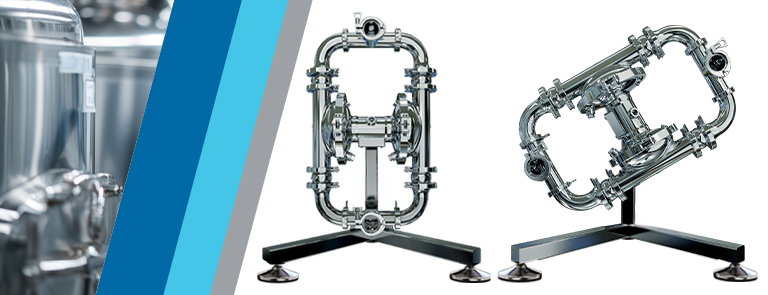
Air-operated double-diaphragm (AODD) pumps transfer the product through the alternating movement of the diaphragms. They do not have a mechanical seal on the shaft in contact with the fluid: this feature may be useful when selecting the technology, but it does not eliminate the need to check the compatibility of the wetted parts.
A hygienic AODD pump may be considered for transferring or draining vinegar and, depending on the configuration, also for viscous products or those containing particles. However, selecting the correct size requires a comparison of the desired flow rate, suction conditions, back pressure and product characteristics.
AODD pumps for mustard and acidic sauces: what’s different?
When assessing pumps for mustard or acidic sauces, checks on materials must be supplemented by checks relating to viscosity and the possible presence of seeds, pulp or spices.
If particles are present, it is necessary to know their maximum size and to check the available passage in the proposed configuration. The mere presence of ball valves does not guarantee that the product can be transferred without difficulty.

What data is needed to select the right pumps for vinegar and acidic sauces?
When choosing a pump for vinegar, mustard or acidic sauces, it is useful to start with the product data and the actual conditions of the production line. This information allows you to assess both the size of the pump and the compatibility of the components in contact with the fluid.
- Product composition or technical data sheet: this is used to identify the characteristics of the formulation to be transferred, rather than basing the choice solely on the product category.
- Temperature during production and cleaning: both must be specified, as the pump comes into contact with both the product and the fluids used for cleaning.
- Viscosity at operating temperature: this helps to assess the product’s behaviour under the conditions in which it will actually be pumped.
- Presence, quantity and maximum size of particles: data required if the product contains seeds, pulp or spices, to verify the available passage in the proposed configuration.
- Required flow rate: this indicates the quantity of product to be transferred per unit of time and is one of the pieces of information required to determine the pump size.
- Suction and discharge pressure conditions: these describe how the pump will be connected and the conditions it will encounter during transfer.
- Intended cleaning procedure: this includes cleaning methods, detergents, sanitisers and cycle conditions to be taken into account when selecting components.
- Documentation requirements for food contact: these enable us to verify that the documentation for the selected components meets the application’s requirements.
Gathering this information before requesting a quotation ensures a more accurate technical assessment of the pump and the configuration of the parts in contact with the product. Do you need to transfer vinegar, mustard or an acidic sauce? Send the product specifications and system details to the Debem technical team. Together, we can assess the pump size, the materials in contact with the fluid and the configuration best suited to the operating conditions.
FAQ: Frequently asked questions about AODD pumps for acidic sauces
Is a 316L stainless steel pump suitable for vinegar?
The answer depends on the formulation, temperature and operating and cleaning conditions. The pH value alone is not sufficient to confirm compatibility.
Can an AODD pump handle mustard containing seeds?
This can be assessed, but the maximum size of the seeds must be known and compared with the pump’s internal passageway. The viscosity of the mustard and the required flow rate must also be taken into account.
Is PTFE always the best choice for diaphragms?
There is no single choice that suits every application. In addition to compatibility with the product, the diaphragm’s construction, operating conditions and the documentation required for food contact must be assessed.
Can an AODD pump run dry whilst emptying?
Dry running must be assessed in accordance with the manufacturer’s instructions and the anticipated operating conditions. This feature does not, on its own, mean that the pump can completely empty a tank or the connected pipework.